“By the Latin Bridge”
Sarah Goodman
I could still smell traces of garlic on my fingers that Friday. The smell had been there since dinner on Tuesday, when my housemates and I had prepped my ‘last supper’ as we’d called it—at least, my last for the time being. At that point, I’d still been in my kitchen, surrounded by familiar people and things in the small Minnesota college town that I’d come to call home. Now, standing by the Latin Bridge in Sarajevo, I ran my finger along my bottom lip. Though faint, I could still sense the traces the garlic had left on me. I knew the distinctness of the smell would soon fade, and I wouldn’t miss it once gone. But for that moment, I let the smell remind me of a home that no one around me knew.
It was sometime past ten in the morning on June 28, 2014. Though early, the air already felt thick with humidity. There was also a palpable sense of anticipation that hung in the air. The street had turned into a sea of bodies, but the atmosphere felt subdued as people stood, waiting. According to the banner hanging from the building opposite, this was “The Street that Started The 20th Century.” It was here, driving down this street on this day one hundred years earlier that Archduke Franz Ferdinand and his wife, Sofia, had been shot by a teenage Serbian nationalist—the first shot of a war that would leave millions dead.
This was the reason we were supposed to be there. I could see Rosie’s head bobbing above the crowd not far away and though Maureen’s head was blocked from view, I assumed they were together. They both had strayed ahead of me to be closer to the antique green car parked on the corner. It wasn’t the same car that Franz Ferdinand had been in at the time of his death, but it had nonetheless been cordoned off with white tape. When the clock struck eleven, it would make it official that it had been 100 years to the hour, and the centennial would be complete.
Journalists and other bystanders milled around, some in headscarves, others in aviators. We were all waiting for the same moment, but had come for slightly different reasons. Perhaps someone here was profiling the assassin, or perhaps another was reflecting on the later wars of the Balkans and the layers of history in Sarajevo. Still others of us had no tangible connection, yet simply wanted to be there to witness a bookend of history. As the clock marshaled us on toward the hour, it occurred to me that when it finally struck, I would be observing a different memorial that morning, a different loss from the one anticipated by the people around me.
I should have been in Ireland, where I had studied abroad the previous fall, doing research for my senior thesis. But when three of my Irish friends had heard I was coming back to Dublin, they invited me to tag along on their brief foray to Sarajevo. Even though I knew it would mean losing a week of research time, I’d agreed without hesitation. I scuffed my foot on the sidewalk. From where I was standing, I couldn’t see Eoin but I knew he couldn’t be far away. He liked Diet Coke, and I imagined him at a concessions stand, haggling over the price in Bosnian marks. Rosie looked back at me and smiled, raising her hand in the air to beckon me to come join her. I smiled back, but shook my head. This was their trip. They had planned it, and they would have gone together had I not been there. So here I was, I thought wryly: in Sarajevo on someone else’s vacation, observing a commemorative moment unfolding around me that I had no real connection to.
But I did have a connection to the date itself. The truth was, since February, the 28th of each month had come to mean something else to me. Four months earlier on a snowy highway, I had lost a friend in a car accident. When I first heard the news, I think I had been too stunned to react. I hadn’t known what I had lost, not really. Initially, it had been easy to imagine that he was out of sight somewhere else around campus. But now, four months out seemed at once distant from the event, and also like it was the very beginning. There was a silence that I was recognizing now which I hadn’t discerned before. With the perspective of four months, I was starting to sense the absence of what had been there before and was now gone.
In early March, I’d found the letter in my mailbox about the grant. I’d applied for summer travel funding not long before, but it felt like an age had gone by. I remember reading the letter from the Dean’s Office, which in politely congratulatory terms, detailed my scholarship to return to Ireland for the summer. I had stared at the fresh flowers and untouched candy still in my mailbox, before refolding the letter and placing it back where I’d found it. It would stay there, between the condolence cards, for another two weeks—once the wake, funeral, and then midterms were behind me.
In April, I’d sent Rosie a message. She had been one of the closest Irish friends I’d made during my semester studying at Trinity College in Dublin, and the prospect of returning to Ireland that summer had started to seem real. The past two months had given me ample cause to reflect on the different people in my life, and I had wanted to tell her that even though our paths had crossed for so short a time, her friendship was important to me. The email was longer than I’d meant for it to be—I hadn’t meant to say anything about the accident, but it had spilled out all the same. Her reply came a while later. I worried that I’d shocked her inadvertently. Our friendship to that point had been doled out in cups of coffee, and I wondered if perhaps I strayed beyond the bounds of what she felt comfortable with. But when her answer came, it was warm. We’d been in touch consistently in the ensuing months. She was going to be working a retail job in Dublin for most of the summer, barring a brief trip she and her housemates were planning to Bosnia. They had made an excursion through the Balkans the summer previously and had liked Sarajevo the best of the cities they’d visited. In May, Rosie asked me if I’d like to join them.
I was glad I’d come, but it meant that, for the first time since the accident, I was spending the 28th far away from anyone who had known him. This was the first step of the summer, of the rest of the summer, of what would be the rest of college and beyond. And this step was inevitable—I recognized that too. Time has a habit of ushering us along. But taking this first step forward felt like I was taking a step away from him. I threaded my thumb through my blue plastic wristband, and with my forefinger, I pressed my finger into the indentations. There was a different date with the 28th marked there. This death would not get a banner claiming to have closed or opened a new chapter in history, but his passing had quietly shattered a part of my life that, until then, I had never imagined fragile. I knew, looking around, that there was no one nearby who knew what this date meant to me. All eyes were on the car parked by the Latin Bridge, still waiting for a clock to chime.
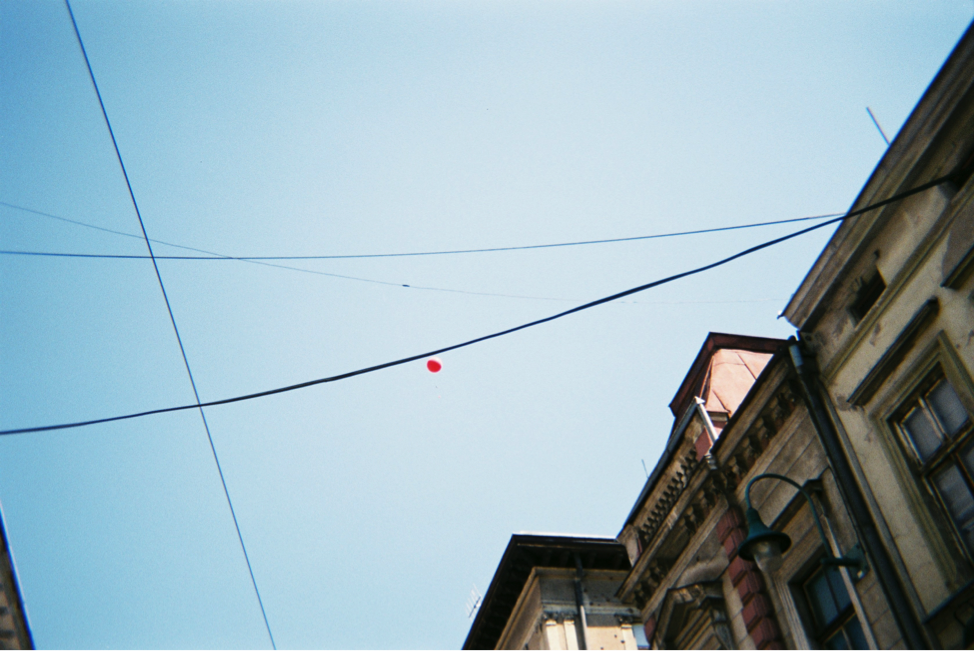
And then I saw it, rising like a soap bubble from a few streets over. A red balloon emerged over the rooftops and was quietly slipping away. I didn’t know who had cut it loose, or why. It was too far beyond my reach to bring it back, and I knew that I couldn’t reverse what had happened. In a few minutes, the balloon would be gone and the street would seem the same to anyone who hadn’t noticed it go. It was drifting through the mismatched triangles overhead, set against the sky by crisscrossing telephone wires. I found myself reaching for my camera, and turned away from the bridge for that moment to salute the balloon with a photograph—to keep a part of it with me even when the balloon itself had disappeared. I craned my neck upward to watch it go. It was a red blip against a blue sky, and I watched until it was gone.